
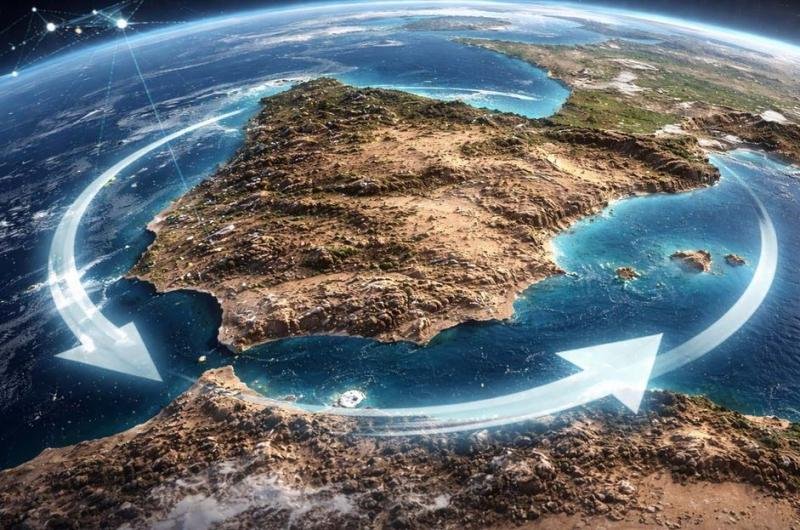

London . The Iberian Peninsula, located between Europe and Africa, which includes Spain and Portugal, is rotating very slowly from its place. Scientific research has revealed that this change is so subtle that common people cannot feel it, but through modern technology and scientific analysis, clear signs have emerged. This important discovery related to the earth’s surface has sparked a new debate regarding geological activities. According to research, the Iberian Peninsula is rotating in a clockwise direction. For this, scientists deeply analyzed the data of satellite-based GNSS tracking stations and signals of earthquakes of the last several years. These data revealed that this region is not completely stable, but is rotating very slowly. This rotation is less than one millimeter per year, which is impossible to sense with the human eye or everyday experience. Scientists say that its speed is less than the speed of growth of human nails. This geological change is mainly believed to be the result of the mutual collision between the African and Eurasian tectonic plates. These two plates are continuously moving towards each other and the pressure between them is affecting the Iberian Peninsula.
This peninsula is like a block stuck between these two huge plates, on which the pressure does not fall equally. Due to this uneven pressure, this area is rotating slightly instead of moving straight. The area around the Strait of Gibraltar is playing a special role in this process. According to scientists, the Gibraltar Arch acts like a buffer, which absorbs tectonic pressure to some extent. In the eastern part of the arc the stress is relatively low, while in the western part the collision of plates is more direct and strong. For this reason, the southern and western parts of the Iberian Peninsula show more clear signs of rotation. At the same time, its northern part is considered more strongly connected to the Eurasian Plate. The biggest question arising after this discovery is whether this could increase the risk of earthquakes in future.
Scientists have not warned of any immediate or major danger at present. He says the rotation speed is very slow and the tension is released slowly over a long period of time. However, this study may prove helpful in identifying areas where geological stress is accumulating and where earthquake tremors have been felt before. The research will help scientists better understand and map the invisible fault lines present beneath the ground.