
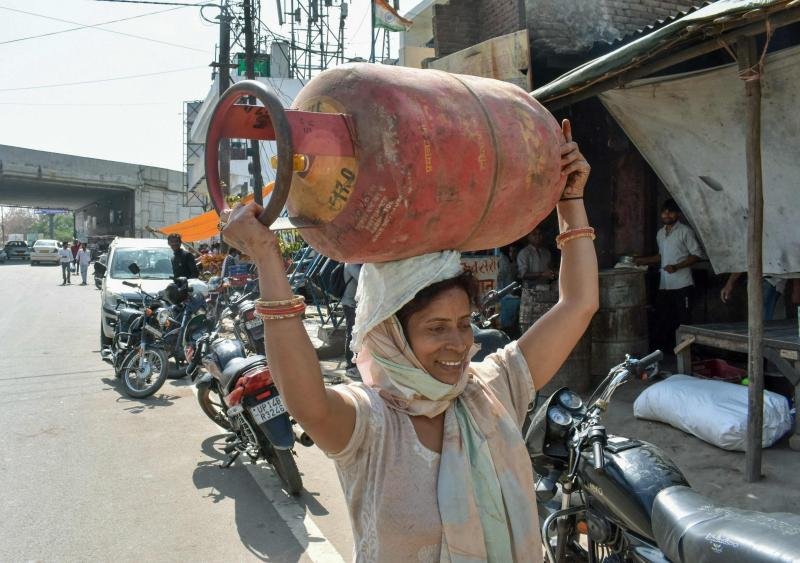

New Delhi: In India, Liquefied Petroleum Gas (LPG) is mostly used for cooking in homes. This trend has further accelerated in the last 10 years due to large welfare programs and growing distribution network. Analysis of national energy data reveals that there is a huge difference in the use of LPG and Piped Natural Gas (PNG) across the country. Although LPG cylinders have reached even remote rural areas through schemes like Pradhan Mantri Ujjwala Yojana (PMUY), PNG connections are still limited to some urban areas where pipeline infrastructure has been developed.
LPG cylinders can be easily transported and are available over large areas, unlike PNG which is supplied through pipelines, which requires a lot of infrastructure. These show India’s successful push for clean cooking fuel, but they also show that India is still struggling to transition to a gas-based economy.
There has been a tremendous increase in LPG consumption in India in the last 30 years. This is due to the improving economy and increased access to cooking gas through new domestic LPG schemes. The reason for this is to expand these schemes through the policy initiatives of the Government of India.
According to data from the Petroleum Planning and Analysis Cell, total LPG consumption in India is projected to increase nearly six times by 2025-26 from 446,000 metric tons (TMT) in 1998-99.
The 2000s and 2010s were the fastest growing years for LPG consumption in India, as average annual consumption grew between 8% and 11%. The launch of the PMUY scheme led to a huge increase in the rate of LPG consumption in 2016-17, when LPG consumption across India increased by about 10.1% year-on-year, mainly due to the addition of lakhs of new households to the total number of households using LPG. But since 2020, there has been a sharp decline in the installation and usage of LPG, as LPG connections have already been distributed to households in almost all areas of the country. Before PMUY, village households were heavily dependent on fuel like wood, farm produce and cow dung for cooking, and PMUY completely changed this dependency by providing free LPG connections to low-income households with either free or subsidized cylinders, making LPG service an option for village kitchens. LPG cylinders can be transported by road to almost any part of the country, whereas PNG requires large pipeline networks, city gas distribution systems And urban planning integration is required.
States with largest LPG consumer base
The pattern of LPG usage across states reflects India’s demographic distribution and welfare coverage. Uttar Pradesh alone accounts for about 15% of India’s total LPG consumers, highlighting the level of dependence on LPG in the country’s most populous state.
Under PMUY scheme
- There are 1.88 crore beneficiaries in Uttar Pradesh.
- There are 1.24 crore beneficiaries in West Bengal.
- There are 1.18 crore beneficiaries in Bihar.
- There are 89 lakh beneficiaries in Madhya Pradesh.
- There are 74.3 lakh beneficiaries in Rajasthan.
The rural population is also quite high in these states. According to census data:
- Rural population in Uttar Pradesh: 77.7%
- Rural population in Bihar: 88.7%
- Rural population in Madhya Pradesh: 72.4%
- Rural population in Rajasthan: 75.1%
There is such a high demand for LPG connections in these states because of their abundance in villages.
Urban families use more LPG
Despite the number of LPG users being higher in rural states, data shows that urban households use LPG significantly more.
For example:
- Delhi households use an average of 11.4 kg of LPG per month
- Households in Uttar Pradesh use about 7.7 kg of LPG per month.
- Bihar households use around 6.7 kg LPG per month
Since a standard domestic LPG cylinder contains 14.2 kg of gas, a household in Bihar uses less than half the cylinder every month. This shows that many rural households with LPG connections are still cooking with old fuel sources or using cylinders for long periods. The consumption gap is closely linked to the distribution of PMUY beneficiaries.
Since most PMUY connections are in rural areas, many households have LPG but use it less compared to urban households, which are almost entirely dependent on LPG for cooking. Gas usage patterns are influenced by income distribution. Generally, in states with higher incomes, the average monthly usage of LPG per household is higher, which reflects their higher purchasing power and dependence on LPG for cooking.
When we compare total LPG consumption and average LPG consumption per household, there is a clear contradiction. States with high population and high LPG connections like Uttar Pradesh, West Bengal, Bihar and Madhya Pradesh are at the top in total consumption; But, they are far below the average consumption per household. For example, LPG consumption in Uttar Pradesh is highest at 377.4 TMT per month; However, in terms of average household consumption, it ranks 22nd in the country. This shows that although LPG connections have increased a lot, the actual amount of LPG consumed by each household does not have any special meaning or reason geographically.
PNG’s growth is not stable across the country
LPG is still the main fuel used for home cooking; However, PNG is continuing its growth given the expansion of CGD network across the country. There are differences in different regions of India regarding the reach of PNG.
Western India is at the forefront
- The level of PNG adoption is highest in western states.
- About 71.8 lakh PNG connections
- 15.7% penetration as compared to LPG consumers
- Gujarat leads with 39.7% PNG penetration, which is the highest in the country. Gujarat was one of the first states to adopt city gas distribution network.
- PNG has also seen good growth in Maharashtra, where there are about 36.17 lakh connections, which shows about 14% penetration compared to LPG users.
PNG expansion in northern India
- PNG’s reach in the northern states is good.
- There are 41.37 lakh PNG connections in this region, which represents 6.1% penetration.
- In this area:
- PNG penetration in Delhi is about 29.3%.
- There are only 16.5 lakh PNG connections in Uttar Pradesh.
PNG’s reach limited in eastern India
So far, it is estimated that: 4.48 lakh PNG connections have been provided in Eastern India and the penetration is 1.4%. There are many users of LPG in the states of West Bengal and Bihar; However, they have limited pipeline infrastructure.
south india
Similarly, South India has around 10.36 lakh PNG connections and 1.5% penetration. Although the number of LPG users is large in Tamil Nadu and Kerala, the piped gas infrastructure in big cities is limited.
Very little reach of PNG in North-East
The North-East region has only 1.2 lakh PNG connections, which is about 2% of the LPG consumers. Due to geographical challenges and limitations of the national pipeline infrastructure, LPG cylinders have become the main source of cooking fuel across India.
Increase in LPG infrastructure
According to the Census of India, there has been a significant increase in the supply of LPG to consumers across India since the last census.
Since April 2014…
- LPG connections increased from 14.52 crore to 32.83 crore.
- LPG distributors increased from 13,896 to 25,532.
- More than 90% of new distributors serve rural areas.
- More than 30.43 crore LPG consumers are registered under the PAHAL Direct Benefit Transfer Scheme, which enables targeted subsidy transfer.
- Meanwhile, under the ‘Give It Up’ campaign, more than 1.14 crore families voluntarily gave up LPG subsidy.
LPG consumption increased in Ujjwala families
Government data shows that the use of LPG is continuously increasing among the beneficiaries of PMUY. Per capita LPG cylinder consumption in Ujjwala families has increased like this:
- 3.01 cylinders every year in 2019–20
- 3.95 cylinders in 2023–24
- 4.34 cylinders (pro-rata) in 2024–25
Since the launch of the scheme, approximately 222 crore LPG refills have been delivered to PMUY households, and approximately 13 lakh refills are being taken daily.
Energy security concerns and the Hormuz factor
India’s LPG expansion also increases the risk of disruptions in global energy supply. About 60% of India’s total LPG needs are imported, of which 90% comes through the Strait of Hormuz, a major route for oil trade in the world. About 20 million barrels of crude oil per day could be transported through the Strait of Hormuz in 2024; This quantity is about 20% of the world’s total petroleum liquids (petrol, diesel, LPG) consumption. Any disruption in the flow of crude oil from the region could lead to shipment delays, increased freight and insurance costs, or delays in finding a fuel source. The risk of such disruptions is particularly high for India, as LPG is an essential fuel used for cooking by millions of households in the country.
Shift to a gas-based economy
Additionally, India is investing in developing its natural gas infrastructure to shift its energy sources away from imported LPG and toward a gas-based economy.
Key developments include:
To increase the length of operational gas pipelines in India from 15,340 km (2014) to approximately 25,000 km (2024). At least 10,800 km of new pipelines will be added. Pipes are allowed for city gas distribution in 307 geographical areas. The tariffs of pipelines will also be made uniform so that they can be made affordable and available. The objective of these measures is to connect large demand centers and lead to large-scale adoption of PNG over time.
dual energy transition challenge
The figures reveal a dual challenge to India’s domestic energy transition. On the one hand, LPG has reached almost everyone due to strong welfare programs and flexible distribution system. On the other hand, because India is still expanding its PNG infrastructure, much of which is currently developed primarily in India’s urban areas; In effect, it is a two-speed transition where most rural/semi-urban areas will use LPG for cooking, while more developed, urban areas will be slower to adopt PNG.
Meanwhile, India’s dependence on imported LPG poses major risks to India’s energy security in the form of geopolitical disruptions or blockages on maritime trade routes.