
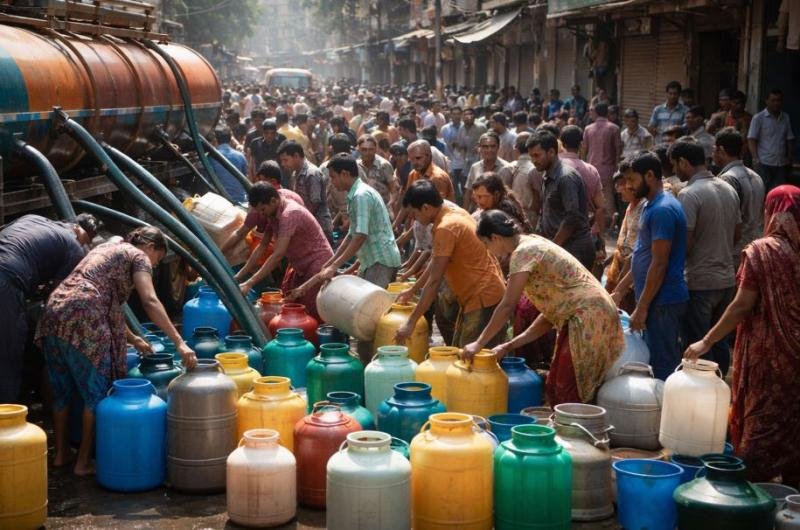

New Delhi. The research being done and the upcoming reports regarding the water crisis are quite scary. A NITI Aayog report had already warned that by 2030, about 40 percent of India’s population would not have adequate access to clean drinking water. Cities like Delhi, Kolkata, Chennai, Bengaluru and Hyderabad have now joined the list of most water-stressed areas in the world. The situation in many areas is so dire that people are completely dependent on water tankers and are forced to stand in long queues for hours to get their basic needs.
In recent years, photographs from Bengaluru of people waiting for tankers with empty containers have highlighted the magnitude of the problem. Earlier in the year 2019, Chennai had also faced a similar dire crisis. Experts clearly believe that this shortage of water in cities is no longer limited to summer only, but has taken the form of a permanent crisis. Uncontrolled groundwater exploitation, dilapidated water supply infrastructure, extinction of lakes and ponds and rapid urbanization are the main reasons behind the urban water crisis. The underground water level through borewells is continuously falling, while a large amount of water is wasted due to leakage in old pipelines. To solve this problem, researchers at Stanford University have suggested a new model in the Earth’s Future Journal. The example of Pune city shows that if farmers are legally allowed to sell surplus irrigation water to urban households through a regulated tanker network, water costs can be reduced significantly. According to research, by implementing the right policies, even by increasing the total water supply by just one percent, at least 40 liters of water can be provided to every person per day. It is clear that water conservation and effective management is the only permanent solution to this crisis. According to global estimates, by the year 2050, half of the world’s urban population will be in the grip of water crisis, of which Indian cities may have the highest number. According to a study by Stanford University, if the current situation does not improve, low-income urban families may have to spend about 20 percent of their total income just on purchasing water.