
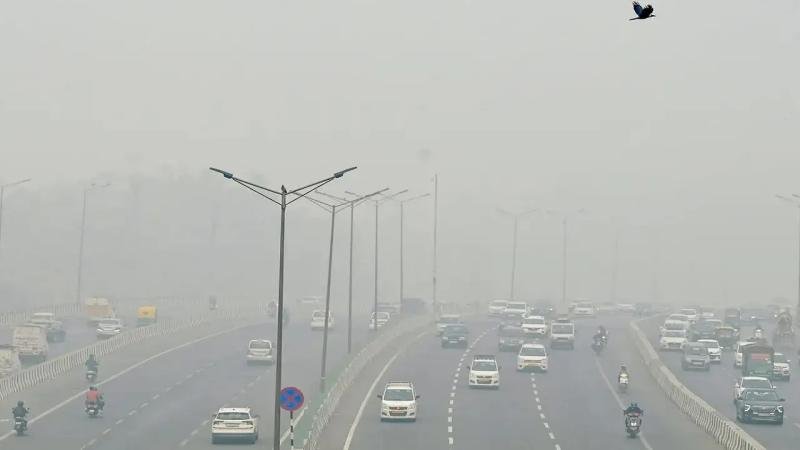

Delhi Air Pollution has once again reached worrying levels. On Saturday, the average air quality index (AQI) of the capital Delhi was recorded beyond 400. AQI was recorded at 401 in the morning, whereas it was around 349 a day earlier on Friday. In view of the continuously worsening air situation, the third phase of the Graded Response Action Plan (GRAP) i.e. GRAP-3 has been re-implemented in Delhi-NCR.
Smog and breathing problems in Delhi-NCR
Dense fog was seen in Delhi as well as surrounding areas like Noida and Ghaziabad on Saturday morning. With visibility reduced, people had trouble breathing. According to experts, the wind speed was very low on Friday night and the humidity was high. For this reason, the pollutant particles could not spread in the atmosphere and remained in the form of fog.
GRAP-3 implemented on the instructions of CAQM
Considering the seriousness of the situation, stricter restrictions of GRAP-3 were imposed on the recommendation of the GRAP sub-committee of the Commission for Air Quality Management (CAQM). Its objective is to prevent Delhi Air Pollution from reaching more dangerous levels.
What will remain closed under GRAP-3?
There will be a complete ban on all non-essential construction and demolition work in Delhi-NCR during GRAP-3. This includes work like earthwork, digging, welding, painting, plastering, tiling and flooring. Operation of ready-mix concrete (RMC) plants will also remain closed. There will also be a ban on transportation of construction materials like cement, sand and fly ash.
Strictness on vehicles and fuel
During GRAP-3, entry and operation of BS-III petrol and BS-IV diesel four-wheelers has been banned in major cities of Delhi and NCR. Even old diesel goods vehicles will not be able to run. There will be a ban on the use of coal, wood and unapproved fuel. Use of diesel generator sets will also be prohibited, although emergency services have been exempted.
Changed the method of teaching in schools
In view of pollution, students up to class five will study in hybrid or online mode. Whereas in higher classes, classes will be conducted with masks and other precautions.