
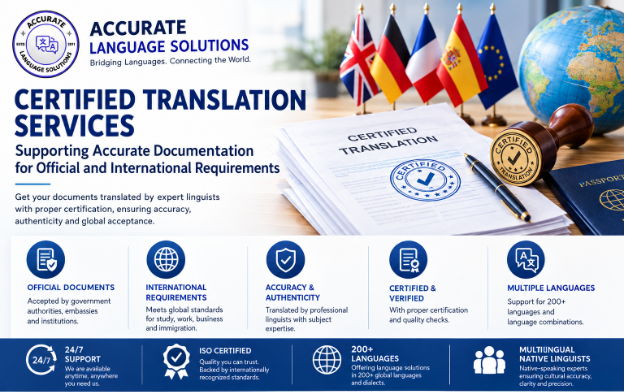
As individuals pursue overseas education, employment, immigration and international business opportunities, accurately translated documents have become an important part of many application and administrative processes. Certified Translation Services in India can help applicants and organizations prepare translated records for submission to universities, government departments, embassies, employers and other institutions, depending on the requirements of the receiving authority.
Unlike general translation, certified translation involves a formal declaration or certification intended to establish the translation’s accuracy and completeness. However, certification requirements are not identical across institutions or countries. Understanding what the receiving authority accepts before commissioning a translation can help prevent avoidable delays and resubmissions.
Why Certified Translation Is Required
Official documents are often issued in a language that differs from the language accepted by the institution reviewing them. A university abroad may request an English translation of academic records, while an immigration authority may require translated civil documents to accompany an application.
Common documents that may require certified translation include:
- Personal records: Birth certificates, marriage certificates, affidavits and other civil documents.
- Academic records: Degree certificates, diplomas, transcripts and educational credentials.
- Legal documents: Contracts, court-related papers, declarations and powers of attorney.
- Immigration documents: Supporting records submitted for visas, residency or other application processes.
- Business documents: Corporate records, agreements, financial documents and official company paperwork.
Whether certification is mandatory depends on the destination, document type and receiving institution. Applicants should confirm the requirements rather than assume that every translated document must follow the same process.
Certified Translation for Education and Employment Abroad
Students applying to international universities may be asked to submit translated academic transcripts, degree certificates, diplomas and other supporting records. Employers and professional organizations may also request translated qualifications or employment documents when assessing an applicant’s background.
In these cases, accuracy extends beyond the general meaning of the text. Institution names, course titles, grades, dates, seals and registration details must be represented consistently. If the receiving institution specifies a particular format or translator declaration, that instruction should be shared with the translation provider before work begins.
A carefully reviewed translation can make supporting documentation easier for the receiving institution to assess, although acceptance ultimately depends on its own rules.
Immigration, Visa and Civil Documentation
Immigration and visa applications can involve several types of personal documents, including birth and marriage certificates, affidavits, identity records and other evidence requested by the relevant authority.
Different countries and application categories may have different requirements for translation, certification, notarization and authentication. Some authorities accept a translator’s certification, while others may specify approved translators or additional formalities.
Applicants should check the current instructions issued by the relevant embassy, immigration department or government authority. They should also verify whether the original document, a copy or a particular format must accompany the translation.
This preparation is particularly important when several documents must be submitted together, as inconsistencies in names, dates or other details may require clarification.
Certified Translation for Legal and Business Documents
Companies operating across borders may need translated contracts, incorporation records, commercial agreements, financial statements, declarations and other official paperwork. Legal and corporate translations require close attention to definitions, obligations, terminology and the structure of the original document.
A certified translation may be requested when the document is submitted to a court, public authority, business institution or other organization. The precise requirement varies, and certification should not automatically be treated as equivalent to notarization, an apostille or consular legalization. These procedures serve different purposes.
For documents intended for formal use abroad, businesses should establish the destination authority’s requirements at the outset. This helps determine whether translation alone is sufficient or whether further authentication is necessary.
What the Certified Translation Process Involves
A well-managed project begins with identifying the purpose of the translation and the institution that will receive it. The source documents can then be reviewed for legibility, completeness, language requirements and any specified formatting instructions.
The process may include:
- Document assessment: Confirm the document type, language pair and intended use.
- Translation: Translate the content while preserving names, dates, references and relevant formatting.
- Quality review: Check accuracy, completeness, terminology and consistency against the source.
- Certification: Provide the required certification or translator declaration, where applicable.
- Final delivery: Supply the translated documents in the format and manner agreed for the intended submission.
The exact steps depend on the receiving authority. If the source document contains unclear text, missing pages or discrepancies, these issues should be addressed before the translation is finalized.
Accuracy, Confidentiality and Document Handling
Official records often contain personal information, financial details or sensitive legal material. Applicants and businesses should choose a provider that follows appropriate confidentiality procedures and handles files responsibly.
Quality control is equally important. Names, dates, identification numbers, official seals and legal terminology require careful verification. Proofreading can help identify omissions and inconsistencies before delivery.
AI-assisted tools may support selected translation tasks, but official documents require careful attention to context and exact details. Appropriate human review is important where errors could affect an application, legal process or administrative decision.
Choosing Certified Translation Services in India
Before selecting a provider, applicants should check language-pair expertise, experience with the relevant document type, quality-control practices, confidentiality arrangements and ability to meet the required deadline. Most importantly, they should confirm that the proposed certification format meets the receiving institution’s requirements.
Accurate Language Solutions Private Limited provides multilingual language services, including document translation services and related communication solutions. Individuals and organizations seeking translation support for educational, legal, immigration, personal or business documents can explore its services at https://accuratelangsols.com/.
As international education, employment, mobility and cross-border business continue to generate documentation requirements, certified translation remains an important part of preparing records for official use. Confirming the applicable rules and ensuring that each translation is accurate, complete and appropriately certified can help applicants and organizations approach the process with greater clarity.